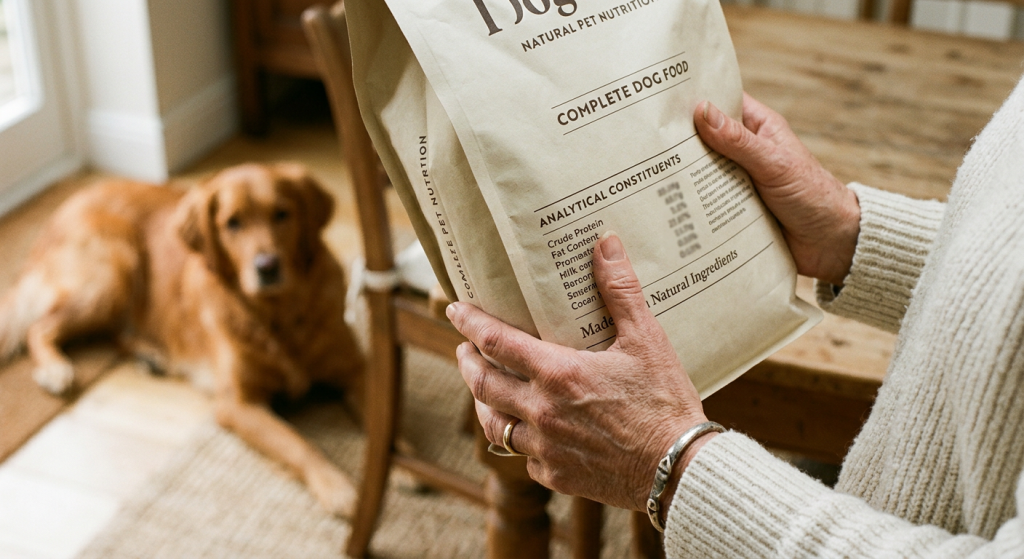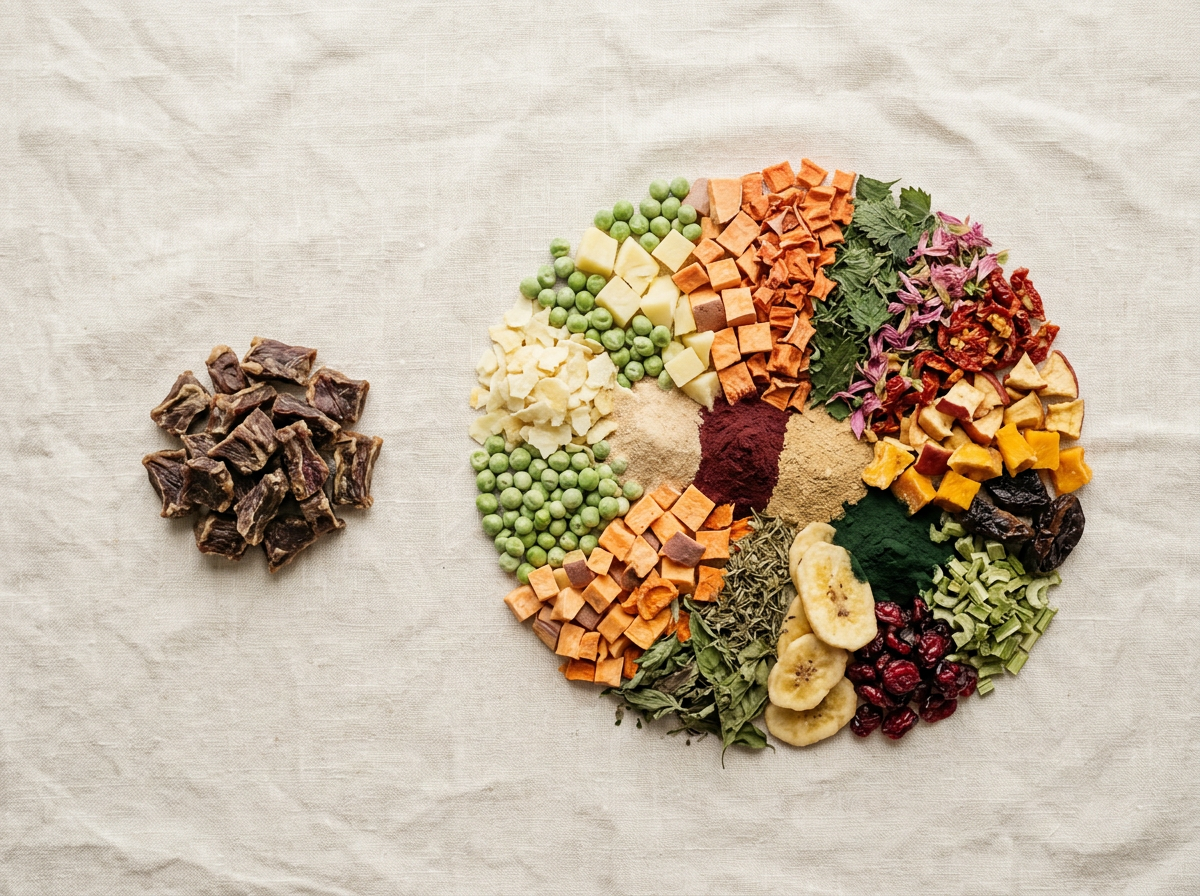
Most of us assume that a pet food labelled “with lamb” contains a lot of lamb. According to the industry’s own published code, it needs to contain just 4%.
That might be the most useful sentence you read today if you buy pet food. And if that surprises you, you are in very good company.
The European Pet Food Industry Federation – FEDIAF – publishes a detailed guidance document called the Code of Good Labelling Practice for Pet Food. The most recent edition was published in October 2019. It sets out, with specific percentage thresholds, what the words and phrases used on pet food packaging are legally required to mean. It is based on EU Regulation 767/2009, which governs the labelling and placing on the market of “compound animal feed”, or as we know it, “pet food”.
The code is not widely read outside the industry. Most pet owners have never heard of it. But understanding even its basic structure changes the way you read a pet food label – and it makes you a more informed buyer for your pet.
Content Claims: What the Words on the Label Are Required to Mean
The FEDIAF code divides on-pack statements about ingredients into what it calls content claims – any reference to the presence or level of a particular ingredient, whether in words, pictures, or graphics on the packaging. Annex 5 of the code sets out a clear hierarchy of these claims for what it terms major components: proteins like chicken, lamb, salmon, and beef; and carbohydrates like rice, white potato or sweet potato.
That hierarchy runs as follows, from lowest to highest inclusion requirement.
“X Flavour” means “0% of the named ingredient”
A product described only as a “flavour” of something — “chicken flavour biscuits”, “beef flavour treats” — can contain 0% of that named ingredient. The flavour is supplied entirely by a flavouring substance, which appears in the Additives section of the label, not in the Composition list. Those bacon flavour treats your dog loves? There is no regulatory requirement for any actual bacon to be present. The taste alone qualifies the claim.
“Flavoured with X” means “More than 0% but less than 4%”
A step up from “flavour”, but a very small one. The product must contain some of the named ingredient, but that amount can be as little as a fraction of a percentage point – provided it is measurably above zero and below 4%. The flavouring additive is still doing much of the work.
“With X” / “Contains X” means “At least 4%”
This is the claim that surprises most people the first time they see it. Under the FEDIAF code, “with lamb” requires at least 4% lamb. That is the floor. A product labelled “with lamb” may be composed almost entirely of other proteins, with lamb playing a minor supporting role that the label nonetheless foregrounds. If multiple ingredients are named — “with lamb and rice”, “with chicken and vegetables” — the 4% minimum applies to each named ingredient separately.
“With lamb” means at least 4% lamb. The rest of the recipe can be almost anything else.
“Rich in X” / “High in X” / “Extra X” / “With Extra X” means “At least 14%”
These terms sound like a meaningful quality statement — and relative to “with”, they are a genuine step up. The threshold is at least 14% of the named ingredient. A product described as “rich in salmon” contains at least 14% salmon. The same rule applies if the word “extra” or “high in” is used: all of these expressions sit at the 14% threshold. Again, where multiple ingredients are named, the 14% applies to each.
Product named after the ingredient means “At least 26%”
When the ingredient forms part of the product’s actual name — “Lamb Dinner”, “Venison Feast”, “Chicken Menu” — the bar is higher still: at least 26% of the named material. This applies whether the name is a variety name or a menu descriptor, and again covers each named ingredient when several are included (“Beef and Chicken Dinner” requires at least 26% of each).
“All X” / “Only X” means “The sole significant ingredient”
The highest tier. Terms like “all beef” or “only chicken” can only be used when the named ingredient is the only significant component in the recipe. Permitted additives, minerals, and water for processing may still be present, but there is no other protein or main ingredient alongside the named one. This is the one claim where the name genuinely tells you what is in the bowl.
The front panel tells you what the brand wants you to notice. The composition list tells you what is actually there – and in what proportion.
The Critical Detail: Percentages Must Be Declared
Here is the piece that changes everything about how to use this information. When a content claim is made on packaging – any claim, from “flavour” through to “all X” – the manufacturer is required to declare the actual percentage of the claimed ingredient in the Composition section of the label. The regulation (EU 767/2009, Article 17) states that the name and percentage by weight must be indicated when presence of an ingredient is emphasised.
So the 4% floor for a “with lamb” claim does not mean you cannot know how much lamb is really in the product. It means that, absent any declaration, the worst it can be is 4%. The declared percentage may be in the ingredient list. If not, it is in the name – you just have to know how to look for it, and know what it means.
If a label says “with salmon (8%)” in the composition list, you know there is 8% salmon in the recipe. If it says “rich in chicken (28%)”, that amount is also there. The claim language on the front panel is the marketing layer; the composition list is the factual layer. Both are on the same pack.
What About Minor Ingredients?
Not every ingredient claim follows this major-component hierarchy. The FEDIAF code distinguishes between major components and what it calls minor components — ingredients added in small amounts that contribute nutritive value, a beneficial effect, or that help characterise the product. Think parsley, chicory, blueberry, rose hip, turmeric, kelp.
For minor components, there is no specific percentage floor equivalent to the 4% or 14% thresholds that apply to proteins and main ingredients. What the code does require is that the inclusion level be sufficient to actually deliver the characterising or beneficial effect – it cannot be a trace amount used purely for label appeal. And as with major components, the inclusion level must be declared in the composition list when the ingredient is highlighted on the packaging.
Why Some Brands Say More Than They Have To
Once you understand this framework, the packaging choices of different brands start to look very different. Some brands use claim language — “with”, “rich in”, “contains” — because it is permitted, meaningful within its limits, and effective marketing. Other brands choose to declare exact percentages in the composition list without making a content claim on the front panel, because they want buyers to know the full picture without needing to decode it.
Neither approach is necessarily dishonest. The claims are regulated, and a product labelled “with salmon” may well contain far more than the 4% minimum — the manufacturer simply chose to use the permitted claim language rather than declare a specific figure. What matters is that you know how to read both types of label: the claim tells you what tier the product sits in; the composition list tells you the actual number.
The hierarchy runs from “flavour” – which needs none of the actual ingredient – through “with” at 4%, “rich in” at 14%, and a named product at 26%, all the way to “all” or “only”, which means exactly what it says.
Celtic Connection declares exact ingredient percentages on every recipe. See our dog food and cat food ranges.
Frequently Asked Questions
Does “with lamb” mean there is very little lamb in the product?
It means there is at least 4% lamb since that is the regulatory minimum for using the word “with”. That may be the actual amount, or it might be considerably higher. The declared percentage in the composition list will tell you exactly how much is included – if the percentage is present. Look for the ingredient name followed by a percentage in brackets in the composition section of the label.
If a product says “rich in salmon”, does it have more salmon than one that says “with salmon”?
Yes. “Rich in” (along with “high in”, “extra”, and “with extra”) requires at least 14% of the named ingredient. “With” requires at least 4%. Both words commit to a minimum, but the minimum is very different. Again, the composition list will show the actual declared percentage for either claim.
Can a “chicken flavour” product contain no chicken at all?
Yes. Under the FEDIAF code, a product described only as “X flavour” can contain 0% of that ingredient. The flavour comes from a flavouring additive, which will appear in the Additives section of the label. If actual chicken is present, the product would typically use “flavoured with chicken” language instead.
What about a product named after a protein — like “Beef Dinner”? Does that mean a lot of beef?
More than “with beef” or “rich in beef”, yes. When the protein forms part of the product’s actual name, the FEDIAF code requires at least 26% of the named material. That said, 26% still leaves a significant portion of the recipe unaccounted for by the name alone. The composition list will confirm the full picture.
Is this a European rule only?
The FEDIAF code and the underlying EU Regulation 767/2009 apply within the European Union and are followed throughout Europe. Other regions have their own labelling frameworks, though the AAFCO standards used in North America use similar principles. If you are buying pet food sold in the EU or the UK, this is the framework that applies.
Where does this information come from?
The percentage thresholds in this post come directly from Annex 5 of the FEDIAF Code of Good Labelling Practice for Pet Food (October 2019 edition) and are consistent with the October 2011 edition. The legal basis for content claim declarations is EU Regulation 767/2009, Article 17.
Sources
FEDIAF (European Pet Food Industry Federation). Code of Good Labelling Practice for Pet Food, October 2019. Annex 5: Content Claims (pp. 59–62). Available at: www.fediaf.org
FEDIAF. Code of Good Labelling Practice for Pet Food, October 2011. Annex 5: Content Claims (pp. 43–47).
European Commission. Regulation (EC) No 767/2009 of the European Parliament and of the Council of 13 July 2009 on the placing on the market and use of feed. Article 17 (content claims). Official Journal of the European Union, L 229, 1.9.2009. Available at: eur-lex.europa.eu