When owners look at the back of a dog food bag, calcium is usually the number they’re looking for. Is there enough? Is there too much? It’s a reasonable question – calcium is critical for bones, teeth, muscle function, and nerve transmission, and getting it wrong has real consequences. But here’s the thing: the calcium figure on its own doesn’t actually answer the question you’re asking. To understand what that calcium is doing in your dog’s body, you need to know what’s sitting next to it.
These two minerals come as a pair
Calcium and phosphorus don’t work independently. The amount of calcium your dog actually absorbs depends directly on how much phosphorus is present at the same time, and vice versa. Research by Dobenecker and colleagues (2006) confirmed this in dogs. The ratio of calcium to phosphorus in the food measurably changes how much of each the body can absorb. Change one mineral without adjusting the other, and the entire absorption picture changes.
A further study from the same research group at Ludwig-Maximilian University Munich (Kiefer-Hecker, Bauer and Dobenecker, 2018) found something that makes this even more clear: what the body actually defends most tightly is not one mineral or the other, but the combined load of both together. Think of it as the body trying to keep both in balance at once, rather than managing them as separate concerns.
And then there’s vitamin D. Without adequate vitamin D, the gut can’t absorb calcium properly in the first place, which means even a well-balanced Ca:P ratio becomes less meaningful if vitamin D is insufficient. The three work together: vitamin D enables calcium to be absorbed, and the ratio of calcium to phosphorus then determines how much phosphorus makes it through alongside it. A food that gets all three right is doing something that a single calcium percentage simply cannot show you.
“A calcium percentage and a phosphorus percentage, read separately, tell you almost nothing about what those minerals are actually doing in your dog’s body.”
What those declared percentages actually mean
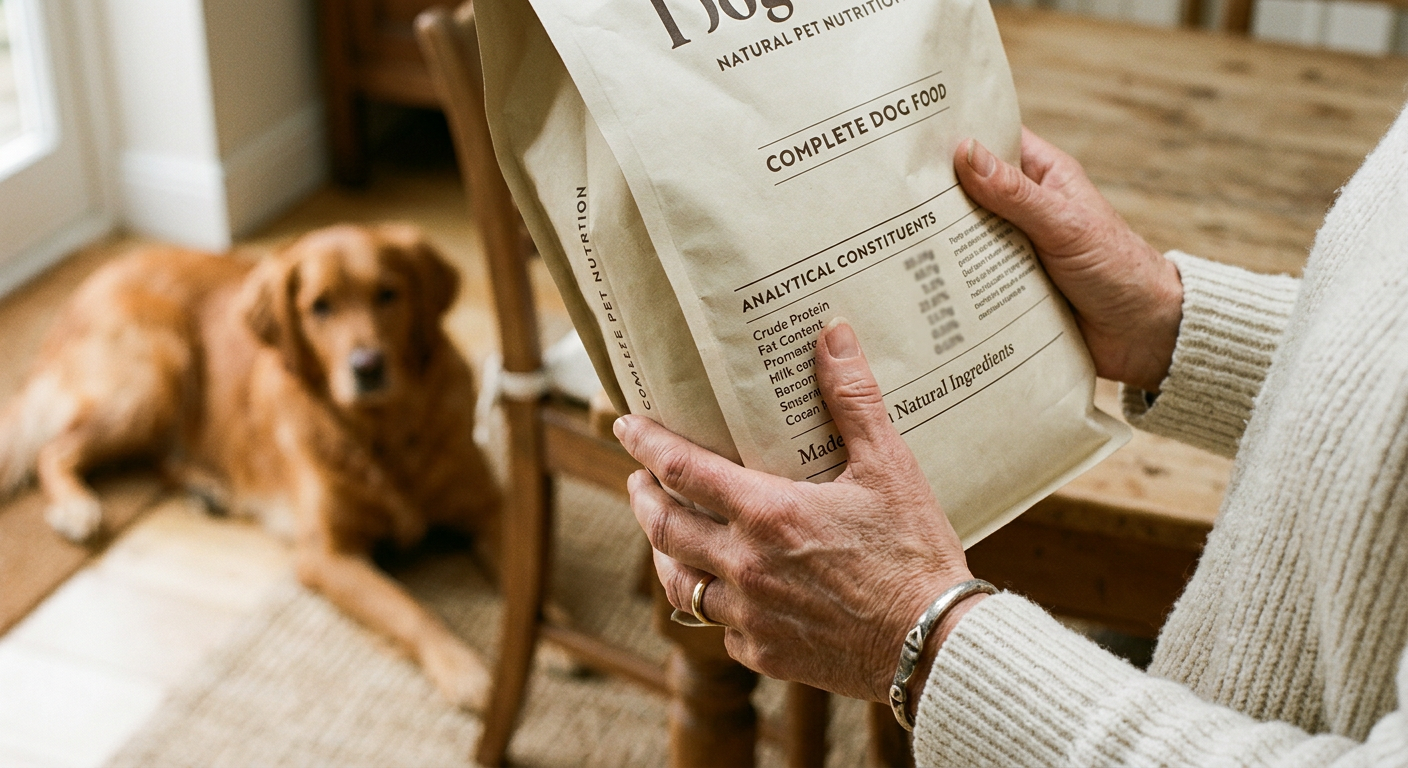
Here’s something that rarely appears on packaging. Under EU Regulation 767/2009, pet food manufacturers don’t even have to declare calcium and phosphorus, they’re optional. The mandatory declarations are crude protein, fats, fibre, and ash. Calcium and phosphorus figures, when they do appear, are there by choice.
When they are declared, the figures represent a typical average across multiple production runs made over multiple years – not the value in the specific bag you’re holding. A declared calcium figure of 1.2% is the mean (middle value) of many different batches, each made with natural ingredients that vary depending on the animals they came from, their age, bone density, diet, and processing conditions. Muscle meat, organ meat, and bone all carry different mineral loads, and those loads shift between runs.
So two separate average figures, listed without any indication of their relationship to each other, don’t tell you whether the calcium and phosphorus in that food are actually balanced. A calcium figure tells you how much calcium is in the food. But whether the body can use it properly depends on what the phosphorus figure is doing alongside it. You’d need to calculate the ratio yourself, and most labels don’t make that easy. The percentages tell you the amounts. They don’t tell you what the body can do with it.
Why we declare a ratio range instead
A ratio tells you the relationship between the two minerals, which is the number that actually determines how well calcium and phosphorus are absorbed. And a range, rather than a single fixed figure, is more honest about what’s really going on in production: natural ingredients are never chemically identical from batch to batch, and declaring a single fixed ratio would imply a precision that simply isn’t achievable with real ingredients.
The Ca:P ratio across Celtic Connection dog food recipes is between 1.01:1 and 1.40:1. This sits comfortably within the ranges recommended by FEDIAF, the European Pet Food Industry Federation. Our recipes are formulated for all life stages, which means the ratio has to work for a growing puppy just as well as it works for a senior dog. Maintaining it consistently between batches is what makes that claim meaningful.
Listing two separate average percentages isn’t more transparent than declaring a ratio range – it’s just a different format. And for understanding what the minerals are actually doing, it’s the less useful one.
Growing dogs
The ratio matters at every life stage, but the stakes are highest when a dog is growing. Both too much calcium and too little phosphorus during growth produce real skeletal consequences, and the window for correction is narrow. The 2018 Dobenecker study showed that puppies on low-phosphorus diets quickly developed muscle weakness and joint problems, but recovered fully once a balanced diet was restored promptly.
An all-life-stages formulation handles this by maintaining a ratio that works for both growth and maintenance without needing to be switched. Within our range of 1.01:1 to 1.40:1, that balance is built in, not just for adult dogs, but for every stage of life.
Celtic Connection recipes are formulated to the ratio, not to an absolute figure. When natural ingredients shift, as they always do, the formulation still remains within the range. That is the standard we set, and the one we refused to compromise.
Questions we often get asked
Does the source of calcium and phosphorus matter, not just the ratio?
Yes, and it’s a good question. Research by Dobenecker and colleagues has also shown that where phosphorus comes from, natural meat and bone versus inorganic mineral salts added in processing, affects how much of it reaches the bloodstream and what load it places on the kidneys. Celtic Connection recipes source calcium and phosphorus primarily from named meat and bone ingredients, not inorganic supplements.
Why a range rather than a single number?
Because natural ingredients vary. Declaring a single fixed ratio would imply we can control mineral levels to the third decimal place across every production run – and we can’t And neither can anyone else using real ingredients. The range tells you what we’re maintaining, honestly. It’s a more useful number than false precision.
If the ratio is what matters, why do some brands still list only percentages?
EU regulations only require the four basic proximate analysis figures. Listing the ratio is a choice. Whether a brand makes that choice, and in what format, reflects how they think about mineral balance, and perhaps how much they want you to be able to assess it for yourself.
What about overfeeding — does that affect mineral balance too?
Indirectly, yes. For most dogs, the single biggest nutritional risk isn’t mineral imbalance, it’s excess calories. Carrying too much weight affects how the body processes everything, including minerals. Getting the portion right is the foundation that makes everything else, including the Ca:P ratio, work as intended. The feeding guide on every Celtic Connection pack and the website gives you a starting point, and the ribcage feel test keeps it calibrated as your dog changes.
Explore our dog food recipes, all formulated to the ratio described above.
Sources
Dobenecker B, Kasbeitzer N, Fischbach W, Schuster S, Kienzle E. Calcium-phosphorus ratio affects phosphorus digestibility in dogs. J Anim Physiol Anim Nutr. 2006;90(3–4):151–155. PMID: 16573684
Kiefer-Hecker B, Bauer A, Dobenecker B. Effects of low phosphorus intake on serum calcium, phosphorus, alkaline phosphatase activity and parathyroid hormone in growing dogs. J Anim Physiol Anim Nutr. 2018;102(6):1749–1758.
FEDIAF. Nutritional guidelines for complete and complementary pet food for cats and dogs. European Pet Food Industry Federation. Current edition.
European Commission. Regulation (EC) No 767/2009 on the placing on the market and use of feed. Official Journal of the European Union. 2009.